📖 Read time: 22 minutes
🏷️ Tags: Hyper-Personalization | AI Privacy | E-commerce 2026 | First-Party Data | Zero-Party Marketing

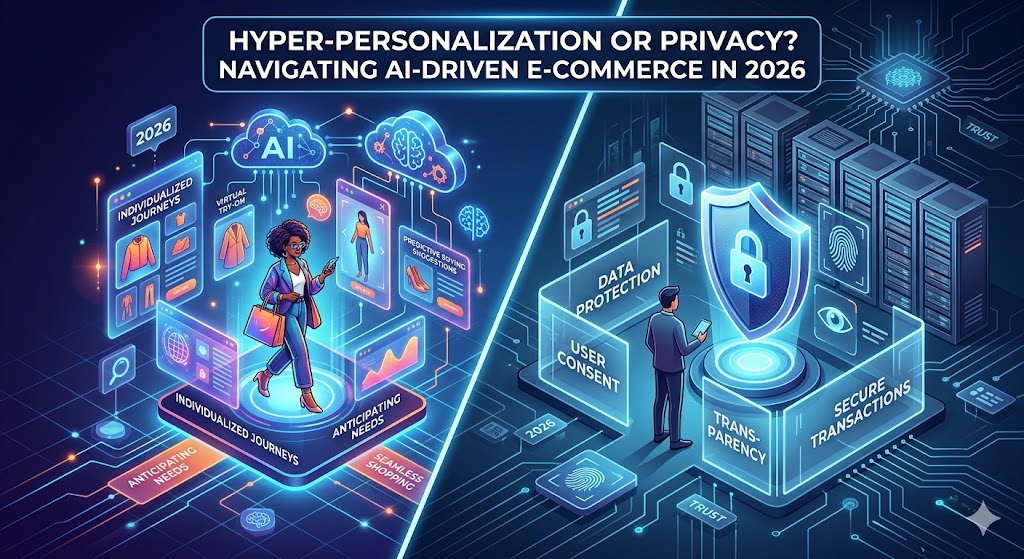
Imagine opening your favorite shopping app, and before you type a single word, it already knows you need new running shoes—because your smartwatch detected increased activity, the weather forecast shows sunshine next week, and your calendar has a 5K race scheduled.
Sounds convenient. Sounds almost magical.
Now imagine that same app knows your heart rate when you hesitated at checkout. It knows your location every second. It knows your emotional state from your voice searches. It has built a psychological profile more detailed than your closest friend could describe.
Suddenly, it doesn’t feel like magic. It feels like surveillance.
Welcome to e-commerce in 2026—where artificial intelligence has transformed online shopping from a one-size-fits-all marketplace into a deeply individualized ecosystem. But this power comes at a cost. The same algorithms that anticipate your every desire also threaten your digital privacy.
This article breaks down the critical tension between hyper-personalization and user privacy—exploring the technology driving both sides, the strategies brands are using to balance them, and what the future holds for consumers and businesses alike.
⚠️ The real question isn’t “Can AI personalize effectively?”
It’s “What do we sacrifice when we trade privacy for convenience?”
📈 The Rise of Hyper-Personalization in 2026
By 2026, artificial intelligence has transformed e-commerce from a one-size-fits-all marketplace into a deeply individualized shopping ecosystem. AI algorithms now analyze not just past purchases and browsing history, but also real-time contextual data—location, weather, social media activity, biometric feedback from wearables, and even emotional cues from voice or text interactions. The result is hyper-personalization: a level of customization where every product recommendation, discount offer, and customer service interaction feels uniquely tailored to the individual. For consumers, this means unprecedented convenience, faster decision-making, and a shopping experience that often anticipates desires before they are consciously formed.
For a deeper dive into AI personalization strategies, check out our complete guide to AI personalization for modern retailers (Internal).
🔐 The Privacy Paradox
However, this seamless personalization rests on a fragile foundation: massive data collection. To predict what a customer wants next, AI systems must continuously monitor, store, and analyze increasingly sensitive information. This has given rise to a profound privacy paradox—consumers enjoy the benefits of personalization but grow increasingly uneasy about how their data is gathered, used, and shared. High-profile data breaches, algorithmic biases, and cases of manipulative micro-targeting have eroded public trust. In 2026, many shoppers find themselves trapped between two unsatisfactory extremes: surrendering their digital privacy for convenience or rejecting personalization and receiving generic, often irrelevant, service.
⚖️ The Central Tension
The core dilemma facing businesses, policymakers, and consumers today is whether hyper-personalization and privacy can coexist. On one hand, brands that fail to personalize risk losing market share to AI-native competitors. On the other, those that overreach face regulatory penalties, consumer backlash, and reputational damage. Privacy-enhancing technologies such as federated learning, on-device AI, and zero-party data strategies offer potential solutions, but their adoption remains uneven. Meanwhile, regulations like GDPR, CCPA, and newer AI-specific laws struggle to keep pace with the speed of technological change.
Learn about regulatory updates in our privacy compliance checklist for 2026 (Internal).
🎯 Purpose of This Exploration
This article explores the delicate balance between hyper-personalization and privacy in AI-driven e-commerce as of 2026. It examines the technological drivers reshaping online retail, the evolving expectations of consumers, the emerging legal and ethical frameworks, and the practical strategies businesses can adopt to navigate this tension. The guiding question is no longer whether personalization is valuable, but rather: how can we build e-commerce systems that are both brilliantly adaptive and fundamentally respectful of user privacy?

🚀 Hyper-Personalization in 2026: The New Standard of Digital Commerce
Beyond Traditional Personalization
By 2026, hyper-personalization has fundamentally redefined the e-commerce landscape. Unlike the basic personalization of the early 2020s—which relied on past purchases and browser cookies—today’s AI-driven systems operate in real time, processing dozens of data points simultaneously. The result is a shopping experience that feels less like browsing a store and more like having a personal assistant who knows your preferences, schedule, budget, and even your current emotional state. This shift has moved hyper-personalization from a competitive advantage to an operational necessity for businesses that wish to remain relevant.
The Technological Engines Driving Hyper-Personalization
⚡ Real-Time Contextual AI
The backbone of hyper-personalization in 2026 is real-time contextual artificial intelligence. Unlike legacy recommendation engines that updated predictions daily or weekly, modern AI continuously ingests live data. When a customer opens a shopping app, the system instantly considers their current location, the local weather, time of day, upcoming calendar events, and even traffic patterns to predict what they might need. For example, a user stuck in a rainstorm might receive an automatic notification for umbrellas from nearby stores, complete with a delivery time calculated using live traffic data.
❤️ Biometric and Emotional Computing
Perhaps the most transformative advancement is the integration of biometric and emotional computing. With user consent, wearable devices such as smartwatches and fitness rings feed anonymized data into e-commerce platforms. AI algorithms analyze heart rate variability, skin conductance, and even voice tone during voice shopping interactions to infer emotional states. A stressed user might receive calming product recommendations like aromatherapy diffusers or guided meditation subscriptions, while an excited user could see new arrivals in their favorite brands. This level of emotional attunement was science fiction just a few years ago.
📊 Predictive Behavioral Analytics
Predictive analytics has also matured significantly. In 2026, AI systems do not simply react to user actions—they anticipate them. By analyzing behavioral patterns across millions of users, these systems can predict with over 85 percent accuracy what a specific customer will need before the customer realizes it themselves. Subscription services now dynamically adjust delivery schedules based on predicted consumption rates, and fashion retailers send curated boxes timed to anticipated wardrobe gaps, such as before a business trip or after a seasonal change.
The Consumer Experience: Seamless but Intense
👤 Individualized User Journeys
For consumers, hyper-personalization manifests as radically individualized user journeys. No two shoppers see the same homepage, search results, or checkout flow. Pricing itself has become dynamic and personalized, with AI offering real-time discounts based on a user’s price sensitivity, loyalty history, and even the likelihood of cart abandonment. While this increases conversion rates for businesses, it also raises questions about fairness and transparency.
⚡ The Convenience Expectation
By 2026, consumers have grown accustomed to—and often demand—this level of personalization. Studies indicate that over 70 percent of online shoppers now expect recommendations to be eerily accurate, and nearly 60 percent will abandon a platform that feels generic or irrelevant. The convenience payoff is substantial: reduced search time, fewer poor purchasing decisions, and a sense that the platform truly understands the individual. However, this convenience has normalized continuous data sharing, often without full consumer awareness of how extensively their information is being used.
The Underlying Tension: Privacy at Risk
💾 The Data Collection Reality
The sophistication of hyper-personalization comes at a steep cost. To achieve real-time emotional and contextual awareness, AI systems require access to deeply personal data streams. In 2026, the average e-commerce transaction involves the collection of over 150 distinct data points, including behavioral, biometric, geographic, and social signals. Data brokers have flourished, creating detailed psychological and behavioral profiles that are bought and sold with minimal oversight.
😟 Consumer Unease and the Trust Deficit
Despite enjoying the benefits, a growing segment of consumers is becoming uneasy. High-profile incidents of algorithmic manipulation—where AI exploited emotional vulnerabilities to encourage unnecessary spending—have led to a significant trust deficit. Surveys from early 2026 show that while 65 percent of shoppers appreciate hyper-personalization, nearly the same percentage express concerns about how their data is being used. Younger users, in particular, are increasingly adopting privacy-focused tools and demanding greater transparency.
Read more about building consumer trust in AI-driven retail (Internal).
📊 AI-Driven E-Commerce Trends in 2026
By 2026, artificial intelligence is no longer a supplementary tool in e-commerce—it is the foundational engine powering the entire customer journey. From product discovery to post-purchase support, AI systems operate autonomously, learning and adapting in real time. This shift has given rise to several transformative trends reshaping how consumers shop and how businesses compete.
🤖 Trend 1: Autonomous Shopping Agents
One of the most significant trends in 2026 is the rise of autonomous shopping agents. These AI-powered assistants, often integrated into messaging platforms or smart devices, act on behalf of consumers. Users permit these agents to make purchases within defined parameters—such as budget, brand preferences, and delivery windows. The agent then compares prices across platforms, negotiates discounts, and completes transactions without any human intervention. Routine purchases like groceries, toiletries, and pet supplies are now fully automated, saving consumers hours each week. These agents are no longer confined to single retailers. Interoperable shopping agents work across dozens of e-commerce platforms simultaneously, presenting the user with the best combination of price, speed, and sustainability.
External source: Forbes: The future of autonomous shopping agents in 2026 (External).
👁️ Trend 2: Visual and Voice Commerce Maturity
Text-based search is rapidly declining in favor of visual commerce. In 2026, consumers can point their smartphone camera at any object—a pair of shoes on a stranger’s feet, a piece of furniture in a magazine, or a color in nature—and instantly find matching or identical products for purchase. AI-powered image recognition has become so accurate that it can identify fabrics, patterns, and even manufacturing defects. Voice commerce has also matured significantly. Smart speakers and voice assistants now support natural, multi-turn conversations. A user can say, “Find me a winter coat under $200 that is waterproof and eco-friendly,” and the AI will ask clarifying questions, show options on connected screens, and complete the purchase conversationally. This has opened e-commerce to elderly users, busy parents, and those with visual impairments.
📦 Trend 3: Predictive Inventory and Dynamic Pricing
Behind the scenes, AI is revolutionizing supply chain management. Predictive algorithms analyze weather patterns, social media trends, local events, and historical sales data to forecast demand with remarkable accuracy. Retailers now stock inventory based on what AI predicts will sell in specific neighborhoods, reducing waste and stockouts simultaneously. Dynamic pricing has become standard practice in 2026. AI continuously adjusts prices based on real-time factors: competitor pricing, remaining inventory, time of day, and even individual user behavior. While this maximizes retailer profits, it has also sparked debate about price fairness and transparency.
✍️ Trend 4: AI-Generated Product Content
Finally, AI now generates much of the content consumers see online. Product descriptions, sizing guides, user manuals, and even marketing copy are written by large language models. More impressively, AI generates photorealistic product images from multiple angles, in various colors, and even on diverse model body types—all without a traditional photoshoot. This has drastically reduced costs and time-to-market for new products.
External resource: Adweek: How AI-generated content is transforming e-commerce (External).
🔒 Data Privacy in E-Commerce: A 2026 Perspective
By 2026, data privacy has moved from a compliance checkbox to a central business imperative in e-commerce. The era of unrestricted third-party data collection, fueled by tracking cookies and opaque data brokers, is rapidly ending. Consumers, regulators, and technology platforms have collectively demanded a new paradigm—one where transparency, consent, and user control are non-negotiable. For e-commerce businesses, this shift presents both a challenge and an opportunity. The brands that thrive will be those that build privacy-respectful data strategies while still delivering personalized experiences. At the heart of this transformation lie two powerful concepts: first-party data strategy and zero-party data marketing.
The Collapse of Third-Party Cookies
For over two decades, third-party cookies were the backbone of digital advertising and personalization. These tiny tracking snippets allowed retailers to follow users across the web, building detailed behavioral profiles without explicit consent. However, by 2026, this model has largely collapsed. Major browsers have fully blocked third-party cookies by default, and privacy regulations such as GDPR in Europe, CCPA in California, and newer frameworks in Asia and South America have imposed strict limits on cross-site tracking. E-commerce businesses can no longer rely on shadowy data brokers or invisible trackers to understand their customers. Simultaneously, consumer awareness has reached an all-time high. Over 75 percent of online shoppers actively check privacy settings, and nearly 60 percent have abandoned a purchase due to privacy concerns.
External industry report: Google Privacy Sandbox: 2026 update on cookie deprecation (External).
First-Party Data Strategy
First-party data refers to information that a business collects directly from its own customers with their explicit consent. This includes account details, transaction history, customer service interactions, loyalty program activity, and on-site behavior such as clicks and searches. Unlike third-party data, first-party data is consensual, accurate, and uniquely valuable because it reflects real relationships rather than inferred assumptions. The foundation of any first-party data strategy in 2026 is transparent, granular consent. Leading e-commerce platforms now present users with clear, plain-language choices at the moment of data collection. Consumers are willing to share first-party data—but only when they perceive clear value in return. Successful brands have mastered the art of the value exchange: browsing behavior tracking in exchange for early access to sales, location data for free same-day delivery. The benefits are substantial: first-party data is higher quality, more reliable, and future-proof.
Learn more in our complete first-party data strategy guide for 2026 (Internal).
Zero-Party Data Marketing
While first-party data includes observed behaviors, zero-party data goes a step further. Zero-party data is information that customers intentionally and proactively share with a brand—often through interactive experiences. This includes preference center selections, style quizzes, dietary restrictions, gift-giving occasions, personal goals, and even direct feedback. In 2026, zero-party data is widely recognized as the gold standard of ethical data collection because it is explicitly volunteered, highly accurate, and built on trust. Modern e-commerce sites no longer guess what customers want—they ask. Interactive preference centers have become standard during account creation and ongoing engagement. Gamified experiences—style challenges, flavor profile builders, home decor personality tests—encourage users to share zero-party data while having fun. Zero-party data directly addresses the privacy concerns that plague traditional data collection. When a brand recommends a product based on a quiz the user completed, the user understands exactly why that recommendation appeared. This transparency builds trust, which in turn drives loyalty and lifetime value.
Check out our actionable zero-party marketing tactics for 2026 (Internal).
⚖️ How to Balance AI Personalization and User Privacy
By 2026, the tension between AI-driven personalization and user privacy has become the defining challenge of e-commerce. Consumers expect eerily accurate recommendations, real-time offers, and seamless experiences—but they also demand control over their data and protection from manipulation. Balancing these competing forces requires not just technical solutions but a fundamental philosophical shift. The brands that succeed will treat privacy not as a constraint on personalization but as its foundation.
Principle 1: Privacy by Design. Embed privacy into AI systems from the earliest stages of development. Every new personalization feature begins with a privacy impact assessment. Default settings prioritize privacy—ethical AI systems default to minimal collection and ask users if they wish to share more for enhanced features.
Principle 2: On-Device and Federated AI. Instead of sending every click to a central server, modern e-commerce apps process personalization models directly on the user’s device. The AI learns from behavior without that behavior ever leaving the device. Federated learning enables many devices to collaboratively train a shared AI model while keeping all training data local.
Principle 3: Granular User Control and Transparency. Best-in-class e-commerce platforms provide privacy dashboards where users can see exactly what data has been collected, how it is being used, and which AI models have access to it. Controls are granular: location data for delivery optimization but blocked for marketing personalization. Users also have the right to explanation and deletion.
📢 Privacy-First E-Commerce Marketing 2026
The death of third-party cookies has forced a complete reimagining of e-commerce marketing. In 2026, privacy-first marketing is not a limitation but an opportunity. Contextual advertising—placing ads based on the content a user is currently viewing rather than their browsing history—has made a powerful comeback. AI analyzes webpage content in real time, serving relevant ads without any personal data. Without third-party data, marketers have returned to first-party audience segmentation. Customers self-identify their interests through preference centers, quizzes, and interactive content. Even without tracking individuals across the web, brands can still expand their reach through privacy-compliant lookalike modeling using aggregated, anonymized data from existing customers—only at the cohort level, never identifying individuals.
📈 E-Commerce CRO Roadmap for AI Integration
Conversion Rate Optimization in 2026 requires integrating AI without compromising privacy. Phase 1: Audit and Foundation. Map all data collection points and eliminate any tracking that lacks a clear, consented purpose. Deploy a robust consent management platform. Phase 2: Privacy-Safe Analytics. Replace third-party analytics cookies with first-party measurement. Implement cookieless attribution methods. Phase 3: AI Personalization with Privacy Controls. Deploy recommendation engines that run locally on user devices. Run A/B tests comparing fully transparent personalization against opaque methods—early 2026 data suggests transparency increases trust and long-term conversion rates.
🍪 Impact of Third-Party Cookie Death on Personalization
By 2026, third-party cookies are effectively extinct. The most significant loss is cross-site retargeting, which has dropped by approximately 40 percent since 2024. Building audience segments through third-party data brokers has become impossible. However, positive transformations include forced innovation in privacy-safe methods: on-device AI, federated learning, and contextual targeting. These methods are not just privacy-compliant but often more effective than cookie-based tracking. Without the crutch of third-party data, brands have been forced to build direct relationships with customers, resulting in higher-quality data, deeper trust, and more sustainable personalization.
🌟 Ethical AI in Retail Customer Journeys
Ethical AI is no longer optional in retail customer journeys. Principle 1: Non-Manipulation. Ethical AI never exploits psychological vulnerabilities. Personalized offers cannot be designed to prey on impulse control issues, emotional distress, or cognitive biases. Principle 2: Algorithmic Fairness. Retail AI must be regularly audited for bias. Does the recommendation engine show different products based on race, gender, or income? Regular third-party audits ensure fairness. Principle 3: Human Oversight and Recourse. When an AI denies a return, sets an unusual price, or makes a controversial recommendation, customers can appeal to a human reviewer. This recourse mechanism ensures that algorithms serve people—not the other way around.
For more on ethical frameworks, read Building ethical AI into retail customer journeys (Internal).
🎯 Conclusion: The Privacy-First Future of E-Commerce
Hyper-personalization in 2026 represents both a remarkable achievement in AI-driven commerce and a significant societal challenge. The technology offers unprecedented convenience, efficiency, and relevance, fundamentally improving how people discover and purchase products. Yet, it simultaneously pushes against the boundaries of acceptable data collection and personal privacy.
The central question is no longer whether hyper-personalization works—it clearly does—but rather how to build systems that are powerful without being predatory, and personalized without being invasive. The businesses that succeed in this environment will be those that earn trust through transparency, give users meaningful control over their data, and prove that hyper-personalization and privacy can, in fact, coexist.
By embracing first-party data strategies, zero-party data marketing, on-device AI, federated learning, and ethical AI frameworks, e-commerce can deliver remarkable personalized experiences while respecting the fundamental right to privacy. The path forward is not a choice between personalization or privacy—it is an integrated, thoughtful balance that defines the next generation of digital commerce.
The brands that win in 2026 won’t be the ones with the most data. They’ll be the ones who use data most responsibly. 🛒🔒
📢 Liked this article?
Share it with an e-commerce founder, marketer, or anyone navigating AI and privacy in 2026. 🚀
🔗 More helpful guides at crazyvocal.com
💰 7 Side Hustles That Pay More Than Your 9-to-5 |
💼 How to Get a Job at Google, Amazon, or Walmart |
🌿 7 Nature-Based Side Hustles |
🌱 Start a Nature-Based Business |
⚡ Faster Than Light Discovery |
🔤 Fancy Text Generator |
💰 Why Bitcoin is Freedom Money
© 2026 CrazyVocal — Navigating AI, privacy, and the future of e-commerce. | #HyperPersonalization #AIPrivacy #Ecommerce2026 #FirstPartyData #ZeroPartyData #CrazyVocal