📖 Read time: 20 minutes
🏷️ Tags: Love is Credit | Relationship is Loan | Marriage Mortgage | Arranged Marriage | Emotional Debt | Wedding Financial Burden

When did love start feeling like a transaction?
You meet someone. You like them. You think this is it — this is the one.
Then comes the family. Then comes the rishta aunty. Then comes the biodata exchange, the property discussion, the income verification, the horoscope matching, the dowry negotiation, the wedding budget, the loan application.
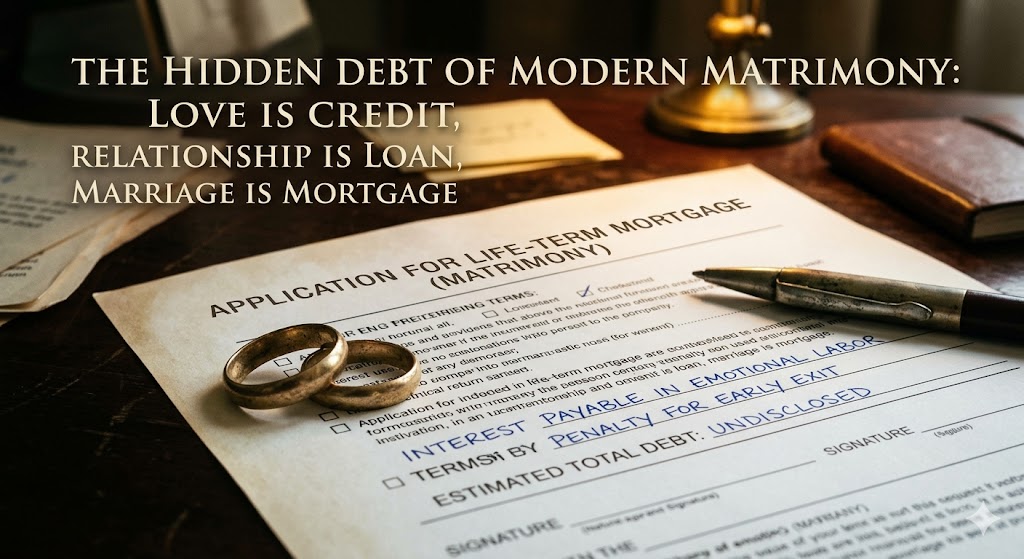
Suddenly, love isn’t love anymore. It’s a credit. The relationship isn’t a connection. It’s a loan. And marriage? Marriage is a lifetime mortgage that you’ll be paying off until your last breath.
This isn’t cynicism. This is reality for millions of people in 2026 — especially in South Asian cultures where arranged marriages still dominate, and even “love marriages” come with a price tag.
Let’s break down the hidden economy of modern matrimony — the emotional debt, the financial burden, the silent suffering, and the uncomfortable truth that nobody talks about at the wedding reception.
💀 The truth bomb nobody tells you:
“Love is free. But marriage? Marriage comes with interest.”
💔 Love is Credit — You Pay Before You Receive
In the world of finance, credit is money given to you with the understanding that you’ll pay it back — often with interest. You get something now, but you owe something later.
Love works the same way.
The Down Payment: Time, Emotion, Sacrifice
Before you even enter a relationship, you’ve already paid. You spent years building yourself — your career, your personality, your appearance, your social status. You invested in education, gym memberships, therapy, fashion, and grooming. All of it was a down payment on love.
In arranged marriage cultures, this down payment is even more explicit. Families spend years building biodata — carefully curated resumes that list education, income, property, family background, and “good looks.” It’s not a love story. It’s a credit application.
And once you’re approved? That’s when the real payments begin.
The Interest Rate: Expectations, Compromise, Silence
Every relationship comes with an interest rate. You might call it “compromise” or “adjustment.” But it’s interesting — the extra you pay for borrowing love.
Doesn’t he help with housework? That’s interesting. She talks too much? Interest. Does his mother control every decision? Interest. Her family expects expensive gifts every year? Interest. Can’t you meet your friends anymore? Interest. You have to pretend to be happy in family gatherings? Compound interest.
By the time you realise how much you’re paying, you’re already in too deep. Emotional debt doesn’t show up on your credit report. But it shows up in sleepless nights, anxiety attacks, and that hollow feeling in your chest when you look at your partner and wonder, “Is this really what I signed up for?”
For a deeper understanding of emotional debt, read Emotional Bankruptcy: When Relationships Drain You Dry (Internal).

📜 Relationship is Loan — With Fine Print You Never Read
A loan comes with terms and conditions. You borrow money, and you agree to repay it in fixed instalments. Miss a payment? There are penalties. Default entirely? They take your collateral.
A relationship works the same way.
The Loan Agreement: Family Expectations & Social Pressure
When you enter a rishta (relationship) in South Asian culture, you’re not just agreeing to be with one person. You’re agreeing to be with their entire family. You’re agreeing to attend every wedding, every funeral, every Eid gathering. You’re agreeing to send gifts on every occasion. You’re agreeing to host relatives you barely know. You’re agreeing to keep quiet when your mother-in-law criticises you.
That’s the fine print. Nobody reads it. But everyone is bound by it.
And if you try to break the agreement? The penalties are brutal. Gossip. Shame. Family boycott. Social ostracism. “Log kya kahenge?” — the most powerful weapon in the desi arsenal.
The Monthly Instalments: Time, Attention, Loyalty
Every relationship requires monthly instalments. You pay with your time — hours spent listening, comforting, accompanying. You pay with your attention — remembering birthdays, anniversaries, and preferences. You pay with your loyalty — choosing your partner over friends, hobbies, even your own dreams sometimes.
In a healthy relationship, these payments feel natural. You don’t mind because you’re receiving value too. But in a transactional relationship — the kind built on credit, not connection — every payment feels like a burden.
And here’s the real kicker: most people never read the loan terms before signing. They enter relationships based on attraction, family pressure, or fear of being alone. Then they spend years surprised by the fine print.
“I didn’t know his mother would move in with us.” “I didn’t know she expected me to pay for everything.” “I didn’t know he had 2 crore in debt.” “I didn’t know she didn’t want children.”
You didn’t read the contract. Now you’re paying for it.
Learn more about 10 Red Flags in Rishta Culture That Everyone Ignores (Internal).
The Co-Signer: Family as Guarantor
In most South Asian relationships, you don’t take the loan alone. Your family co-signs. Your parents, siblings, and even extended relatives become guarantors of your relationship.
This is why breaking a relationship is so hard. It’s not just your heart on the line. It’s your family’s reputation. Their social standing. Their honour. Their “izzat.”
You might want to default on the loan. But your co-signers won’t let you. So you stay. You pay. You pretend. You suffer in silence because the penalty for defaulting is worse than the loan itself.
External resource: BBC: The hidden pressure of arranged marriages in modern South Asia (External).
🏠 Marriage is Mortgage — A 30-Year Commitment You Can’t Escape
A mortgage is the biggest loan most people will ever take. It ties you to a property for decades. You can’t just walk away. If you stop paying, they take everything.
Marriage is the same — except the property is your life, and the bank is society.
The Down Payment: Wedding Expenses & Dowry
Before you even enter a marriage, you pay a massive down payment. The wedding itself — the venue, the catering, the decorations, the photographer, the honeymoon — can cost anywhere from 10 lakh to several crores depending on your social status.
In many communities, there’s also dowry — an ancient practice that refuses to die. The bride’s family pays the groom’s family for the “honour” of marrying their daughter. Cars, gold, property, cash — it’s all part of the transaction.
And if you can’t pay? The rishta falls through. Because at the end of the day, marriage isn’t about love. It’s about affordability.
A 2025 study found that the average wedding in urban Pakistan costs between 2 and 5 million PKR. In India, it’s between 15 and 30 lakh INR. In both countries, over 60% of families take out loans to cover wedding expenses. They enter marriage already in debt.
That’s not a celebration. That’s a foreclosure notice waiting to happen.
The Monthly Mortgage Payment: Living Together
Once you’re married, the monthly payments begin. Rent or mortgage a home. Utilities. Groceries. Children’s education. Medical bills. Family obligations. Gifts for relatives. Saving for the future.
Both partners work — sometimes two or three jobs — to keep up with the payments. There’s no time for romance. No energy for connection. No space for the love that supposedly started all of this.
The marriage becomes a financial arrangement. You’re not husband and wife. You’re co-signers on a mortgage, co-parents to children, co-employees in the business of survival.
And if one partner stops contributing — loses a job, gets sick, falls into depression — the whole structure wobbles. Because the marriage wasn’t built on love. It was built on a foundation of payments.
External resource: Al Jazeera: The wedding debt crisis crushing South Asian families (External).
Defaulting on the Mortgage: Divorce & Social Death
What happens if you default on a mortgage? The bank forecloses. You lose the house. Your credit is destroyed. You might never get another loan again.
What happens if you default on a marriage through divorce or separation?
In South Asian cultures, it’s often worse than foreclosure. You don’t just lose your partner. You lose your reputation. Your family’s honour. Your place in the community. Your children’s future marriage prospects. Sometimes, even your job, your friends, your entire social network.
Divorced women are especially punished. They’re labelled “damaged goods.” Their families are shamed. Their chances of remarrying drop dramatically. Many are forced to return to their parents’ homes — if their parents will even accept them.
Divorced men face less stigma, but they still pay a price. The divorce itself costs money — legal fees, alimony, child support, and division of assets. And the emotional toll? That’s a debt that never gets paid off.
So most people stay. Even when they’re miserable. Even when there’s abuse. Even when there’s no love left. Because the penalty for defaulting on the marriage mortgage is social death.
Read about Why Divorce is Still a Dirty Word in South Asian Families (Internal).

💰 The Dowry Problem: The Original Hidden Fee
No discussion of love, relationships, and marriage in South Asia is complete without talking about dowry.
Dowry is technically illegal in India (Dowry Prohibition Act, 1961) and Pakistan (Dowry and Bridal Gifts Restriction Act, 1976). But in practice, it’s more alive than ever. It’s just hidden.
Families call it “gifts.” They call it “voluntary contribution.” They call it “tradition.” But everyone knows what it really is: a price tag on a human being.
The groom’s family asks for cash, cars, gold, property, furniture, and electronics. The bride’s family pays — often going into debt for years, sometimes decades — because if they don’t, their daughter might never get married. Or worse, she might be mistreated after marriage for not bringing “enough.”
Dowry-related violence is still a crisis. Every year, thousands of women are harassed, tortured, and even killed because their families couldn’t meet dowry demands. The official statistics are horrifying. The unofficial reality is even worse.
And here’s the most painful part: dowry doesn’t guarantee a good marriage. It just guarantees that the bride’s family paid. The groom might still be abusive. His family might still be cruel. The marriage might still be miserable.
But the payment was made. The transaction is complete. Now everyone pretends everything is fine.
External resource: Human Rights Watch: The ongoing crisis of dowry deaths in South Asia (External).
💸 The End Result: Emotional Bankruptcy
After years of paying credit on love, instalments on a relationship, and the mortgage on marriage, most people end up emotionally bankrupt.
What does emotional bankruptcy look like?
- You feel nothing when you look at your partner — not love, not hate, just numbness.
- You go through the motions of marriage — cooking, cleaning, working, parenting — but you’re not present. You’re a ghost in your own life.
- You’ve stopped fighting because fighting requires energy you don’t have.
- You’ve stopped hoping because hope leads to disappointment.
- You’re waiting for something — death, divorce, a miracle — but you don’t know which.
This is the reality for millions of married people in 2026. They’re not in abusive marriages (though many are). They’re not in loveless marriages (though many are). They’re in empty marriages — relationships that have no debt left to pay because there’s nothing left to collect.
And the saddest part? Most of them will stay until the end. Because emotional bankruptcy doesn’t show up on your credit report. No one can see it. So no one helps. No one intervenes. No one says, “You don’t have to keep paying.”
Read 7 Signs You’re Emotionally Bankrupt in Your Marriage (Internal).
🕯️ Is There a Way Out? Breaking the Cycle
If love is credit, relationships are loans, and marriage is a mortgage — is there any hope for a different kind of relationship? One that isn’t based on transactions?
Yes. But it requires rewriting the contract.
Step 1: Stop Treating Love as Credit
Love isn’t something you earn. It isn’t something you pay back. It isn’t a transaction. It’s a gift — freely given, freely received, with no expectation of return.
If you’re keeping score in your relationship — “I did this for you, so you owe me that” — you’re not in love. You’re in a credit arrangement. And credit arrangements always come due.
Step 2: Read the Fine Print Before Signing the Loan
Before you enter a relationship — especially an arranged one — ask the hard questions. Don’t rely on rishta aunties or family assurances. Talk directly to the person you might marry.
Ask about money, children, in-laws, careers, expectations, and deal-breakers. If you can’t have these conversations before marriage, you definitely won’t have them after.
Step 3: Refinance Your Mortgage
If you’re already in a marriage that feels like a mortgage, consider refinancing. This means renegotiating the terms of your relationship — not ending it, but restructuring it.
Couples therapy. Honest conversations. Setting new boundaries. Redistributing responsibilities. Creating space for connection. It’s not easy. It’s not quick. But it’s better than living the rest of your life in silent debt.
Learn about How Couples Therapy is Changing Marriages in South Asia (Internal).
Step 4: Know When to Declare Bankruptcy
Sometimes, the debt is too high. The interest is too crushing. The mortgage is too suffocating. Sometimes, the only way out is to declare emotional bankruptcy and walk away.
Divorce isn’t failure. Staying in a marriage that destroys you — that’s failure. Your life is not collateral. Your mental health is not an asset to be liquidated. You are allowed to leave. You are allowed to start over. You are allowed to choose peace over payment.
It will be hard. Society will judge. Family will shame. But your children will learn that self-respect matters. Your siblings will see that leaving is possible. And someday, you might even find a love that isn’t credit — a relationship that isn’t a loan — a partnership that feels like home, not a mortgage.
🎯 Conclusion: You Are Not a Transaction
“Love is credit, relationship is a loan, marriage is a mortgage” — this isn’t just a clever phrase. For millions of people in 2026, it’s their lived reality. They wake up every day to payments they never agreed to, terms they never read, and interest they never calculated.
But it doesn’t have to be this way.
You can choose a different kind of love. One that isn’t a transaction. One that doesn’t come with fine print. One that asks for nothing but gives everything.
It starts with honesty — with yourself, with your partner, with your family. It continues with courage — the courage to ask hard questions, set boundaries, and walk away when necessary. And it ends with freedom — the freedom to love without debt, to relate without obligation, to marry without mortgage.
You are not a credit score. You are not a loan approval. You are not a mortgage payment. You are a human being, worthy of love that doesn’t come with interest. 💔➡️❤️
📢 Liked this article?
Share it with someone who needs to hear this truth. 💔
🔗 More helpful guides at crazyvocal.com
💰 7 Side Hustles That Pay More Than Your 9-to-5 |
💼 How to Get a Job at Google, Amazon, or Walmart |
🌿 7 Nature-Based Side Hustles |
🌱 Start a Nature-Based Business |
⚡ Faster Than Light Discovery |
🔤 Fancy Text Generator |
💰 Why Bitcoin is Freedom Money
© 2026 CrazyVocal — Truth about love, relationships, and marriage. | #LoveIsCredit #RelationshipIsLoan #MarriageIsMortgage #EmotionalDebt #ArrangedMarriage #DesiWeddings #DowryCrisis #CrazyVocal