
SEO for Foodies: How to Make Your Recipes Rank #1 on Google (2026 Edition)
The digital food landscape has completely shifted in 2026. It is no longer enough to have a great-tasting dish. You need to satisfy Google’s “Information Gain” requirements and the new Search Generative Experience (SGE).
If you want your recipes to be the first thing hungry users see when they search, you need a strategy that balances technical SEO with mouth-watering content. This guide will show you exactly how to do it.
Whether you are a food blogger, a restaurant owner, or a home cook sharing recipes online, this step-by-step roadmap will help you dominate the food SERPs (Search Engine Results Pages) in 2026.

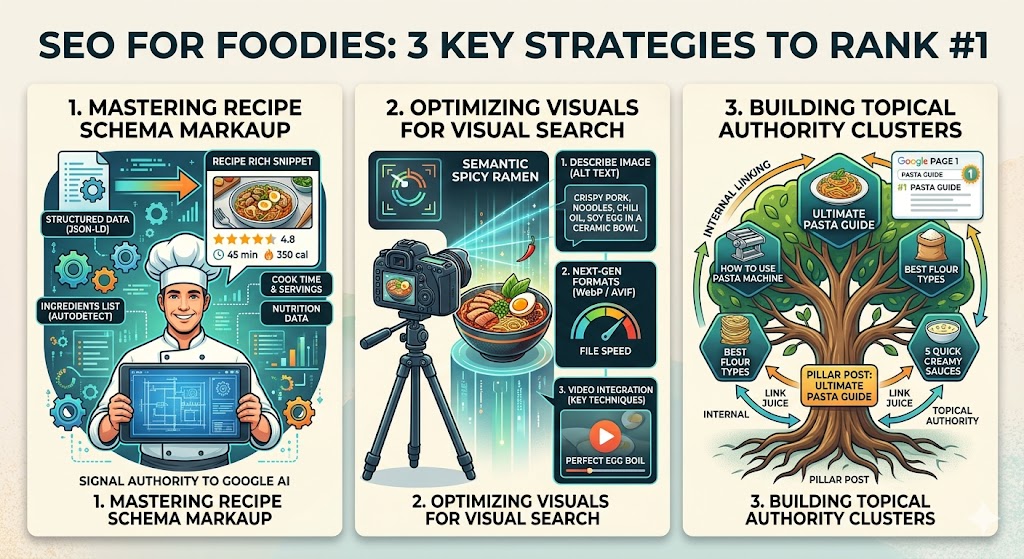
1. Master “Recipe Schema” — The Secret Sauce
In 2026, Google relies heavily on structured data. Schema markup tells Google exactly what your page is about — listing ingredients, cook time, calories, and more in a format it can easily digest for rich snippets and AI-generated answers.
📌 What is Recipe Schema?
Recipe Schema is a type of structured data code that you add to your recipe pages. It helps Google understand:
- Recipe name and description
- Ingredients list
- Cook time and prep time
- Nutritional information (calories, fat, protein, etc.)
- Recipe instructions (step by step)
- Recipe ratings and reviews
- Recipe images and videos
📌 Key Fields You Cannot Skip in 2026
- Video tag: Google prioritizes recipes with video content. Add a short cooking video.
- Instruction steps: Break down your recipe into clear, numbered steps.
- Nutritional information: Calorie counts and macros are now expected.
- Aggregate rating: Star ratings from user reviews increase click-through rates.
- Recipe yield: How many servings does this make?
{
“@context”: “https://schema.org/”,
“@type”: “Recipe”,
“name”: “Easy Air Fryer Chicken Wings”,
“image”: “https://example.com/chicken-wings.jpg”,
“author”: { “@type”: “Person”, “name”: “Your Name” },
“datePublished”: “2026-04-26”,
“description”: “Crispy air fryer chicken wings ready in 20 minutes.”,
“prepTime”: “PT10M”,
“cookTime”: “PT20M”,
“totalTime”: “PT30M”,
“recipeYield”: “4 servings”,
“recipeIngredient”: [
“2 lbs chicken wings”,
“1 tbsp baking powder”,
“1 tsp salt”,
“1/2 tsp pepper”
],
“recipeInstructions”: [
{ “@type”: “HowToStep”, “text”: “Pat chicken wings dry with paper towels.” },
{ “@type”: “HowToStep”, “text”: “Mix baking powder, salt, and pepper in a bowl.” }
],
“nutrition”: {
“@type”: “NutritionInformation”,
“calories”: “250 calories”
}
}
2. Focus on Semantic Keywords & Search Intent
Keyword stuffing is dead. In 2026, Google is smarter than ever. Instead of cramming the same keyword 20 times, you need to focus on Semantic SEO — using related terms that prove your topical authority.
📌 Primary vs Semantic Keywords
Primary Keyword Example: “Easy Air Fryer Chicken Wings”
Semantic Keywords (Related terms): Extra crispy texture, internal temperature for chicken, dry rub vs wet sauce, keto-friendly appetizers, buffalo wings recipe, air fryer temperature settings, how long to cook chicken wings in air fryer.
📌 Understanding Search Intent
Search intent is the reason behind a search. You need to match your content to what the user actually wants.
- Quick meal seeker: “10-minute pasta dinner” — needs a fast, simple recipe with minimal ingredients.
- Health-conscious cook: “low-calorie air fryer recipes” — needs nutritional information and healthy substitutions.
- Professional chef: “sourdough baking techniques” — needs detailed instructions, science explanations, and pro tips.
- Budget cook: “cheap family meals under $10” — needs cost breakdown and affordable ingredients.
Match your tone, formatting, and detail level to what the searcher needs.

3. High-Performance Visuals — The 2026 Standard
Visuals are now a primary ranking factor. Google Lens and visual search mean your images must be optimized for both users and search engines.
📌 Image Optimization Best Practices
- Alt Text: Don’t just write “food image.” Use descriptive text like “Golden brown sourdough bread cooling on a wire rack in a rustic kitchen.”
- File Names: Use descriptive file names. Instead of “IMG_1234.jpg” use “easy-air-fryer-chicken-wings.jpg”
- Next-Gen Formats: Use WebP or AVIF formats to ensure lightning-fast load times without losing quality.
- Compression: Use tools like TinyPNG or ShortPixel to reduce file sizes without visible quality loss.
- Responsive Images: Serve different image sizes for desktop, tablet, and mobile.
📌 Video Integration — Essential for 2026
Short-form video (15–30 seconds) showing a key technique in the recipe significantly increases “Dwell Time” — a massive ranking signal.
- Embed a YouTube video directly in your recipe post.
- Show the most impressive moment: crispy skin tearing, cheese pulling, and sauce pouring.
- Add captions for accessibility and users watching without sound.
- Host videos on YouTube and embed them — YouTube is owned by Google and gets preference.
4. Optimize for Core Web Vitals — Speed Kills
If your site takes more than 2 seconds to load because of heavy, high-resolution photos, users will bounce. And Google will penalize you.
📌 Core Web Vitals Metrics for 2026
- Largest Contentful Paint (LCP): Main content should load within 2.5 seconds. Optimize hero images and server response time.
- Interaction to Next Paint (INP): Ensure your “Jump to Recipe” button works instantly. No lag when users click.
- Cumulative Layout Shift (CLS): Page elements should not move while loading. No sudden jumps that cause users to click the wrong button.
📌 Mobile First — Non-Negotiable
80% of users are looking at your recipe on a smartphone in the kitchen. Their hands might be messy from cooking. Your site must work perfectly on mobile.
- Text must be readable without zooming (at least 16px font size).
- Buttons must be large enough to tap with a flour-covered finger.
- “Jump to Recipe” button must be visible immediately on mobile. The recipe card should be easy to read while the phone is propped up on a counter.
- Use Google’s Mobile-Friendly Test tool to check your site.
✅ Core Web Vitals Checklist
- ✓ Compress all images (use WebP format)
- ✓ Enable browser caching
- ✓ Use a fast hosting provider
- ✓ Minimize plugins (too many plugins slow your site)
- ✓ Use a Content Delivery Network (CDN)
- ✓ Test with Google PageSpeed Insights

5. Build “Topical Authority” with Food Clusters
Google ranks experts, not just individual pages. To rank for a specific recipe, you need a “cluster” of related content around it. This proves to Google that you are an authority on that topic.
📌 What is a Topic Cluster?
A topic cluster is a group of interlinked articles around a main topic. It includes:
- Pillar Page: The comprehensive guide on a broad topic (e.g., “The Ultimate Guide to Italian Pasta”)
- Cluster Content: Specific articles that support the pillar (e.g., “Best Flour for Pasta,” “How to Use a Pasta Machine,” “5 Quick Creamy Sauces for Pasta”)
📌 Example Topic Cluster for “Sourdough Bread.”
- Pillar Page: “Complete Guide to Sourdough Baking for Beginners”
- Cluster 1: “How to Make a Sourdough Starter from Scratch”
- Cluster 2: “Why Isn’t My Sourdough Rising? Troubleshooting Guide”
- Cluster 3: “Best Flour for Sourdough: Protein Content Explained”
- Cluster 4: “How to Score Sourdough Bread (Patterns & Techniques)”
- Cluster 5: “Sourdough Discard Recipes: 10 Ways to Use Extra Starter”
Internal linking is critical. Link all your cluster articles back to your main pillar page to pass “link juice” and authority.
6. The Information Gain Requirement — What Makes Your Recipe Unique?
Google’s 2026 algorithm rewards content that provides NEW information. If your recipe says the same thing as 100 other recipes, you will not rank.
📌 How to Create “Information Gain.”
- Original research: Test different cooking methods and share your results. “I tried baking this bread at 3 different temperatures — here is what happened.”
- Unique tips: Share a trick you discovered that no one else mentions.
- Personal story: Why does this recipe matter to you? “This is my grandmother’s recipe from her village in Punjab.”
- Mistakes to avoid: Tell readers what NOT to do. “Most recipes say to add salt at the beginning. I learned that adding salt at the end makes this dish 10x better.”
- Dietary adaptations: Show how to make the recipe gluten-free, vegan, low-carb, or nut-free.
7. SEO Checklist for Every Recipe Post
✅ Before You Publish — Run This Checklist
- ✓ Keyword in Title: Place your primary keyword near the beginning of your H1.
- ✓ Jump to Recipe Button: Essential for user experience. Users should not have to scroll through 2000 words of stories to find the recipe.
- ✓ Original Photography: No stock photos. Show your actual dish from multiple angles.
- ✓ Recipe Schema: Validated with Google’s Rich Results Test tool.
- ✓ Video Embed: At least one short video showing a key technique.
- ✓ Internal Links: Link to 3-5 related recipes on your site.
- ✓ External Links: Link to a high-authority source (e.g., a study on the health benefits of an ingredient).
- ✓ FAQ Section: Use H3 tags to answer common questions like “Can I freeze this?” or “What can I substitute for [ingredient]?”
- ✓ Nutritional Information: Include calorie count and basic macros.
- ✓ Mobile Test: View your recipe on a smartphone before publishing.
- ✓ Speed Test: Run Google PageSpeed Insights. Aim for 90+ on mobile.
8. Recommended SEO Keywords to Target in 2026
📢 Need Help with SEO Content for Your Food Blog?
Crazy Vocal writes SEO-optimized recipe posts, food guides, and lifestyle content that ranks on Google. Let us help you grow your food blog in 2026.
Frequently Asked Questions (FAQs)
Q1: How long does it take for a new recipe post to rank?
Answer: For a new blog, 3-6 months. For an established blog with authority, 2-4 weeks. Be patient. Keep creating high-quality content. Rankings improve over time.
Q2: Should I put the recipe at the top or bottom of the page?
Answer: Use a “Jump to Recipe” button at the top. Keep your stories and tips above the recipe for SEO (more text = more keywords), but make it easy for users to skip directly to the recipe.
Q3: How many photos should I include per recipe?
Answer: At least 5-7 photos: ingredient shot, step-by-step process shots (3-4), finished dish close-up, and a lifestyle shot (on a table, in natural light).
Q4: Do I need a separate recipe card plugin?
Answer: Yes, highly recommended. WP Recipe Maker, Tasty Recipes, and Create by Mediavine are excellent. They automatically add Recipe Schema for you.
Q5: How do I get backlinks to my recipe posts?
Answer: Share your recipes on social media (Pinterest is gold for food bloggers). Submit to recipe roundups. Collaborate with other food bloggers. Create unique, shareable content like “10 Mistakes Everyone Makes When Baking Bread.”
Q6: What is the ideal word count for a recipe post in 2026?
Answer: 1500-2500 words. Include the recipe itself, tips, variations, ingredient explanations, step photos, and FAQ. Longer, helpful content ranks better.
📝 Ready to Rank Your Recipes #1 on Google?
Crazy Vocal provides SEO-optimized food content, recipe writing, and blog management services. Let us help you turn your food blog into a traffic machine.
Internal Links: Blog Posts That Rank | SEO Creative Writing | How to Write Blog Posts That Google Loves | SEO Keywords Research Guide | Ultimate Travel Guide 2026
📌 Focus Keyword: SEO for Foodies
📌 Secondary Keywords: recipe schema, semantic keywords, core web vitals, topical authority, food blog SEO, Google SGE, recipe ranking 2026
© 2026 Crazy Vocal — All rights reserved.