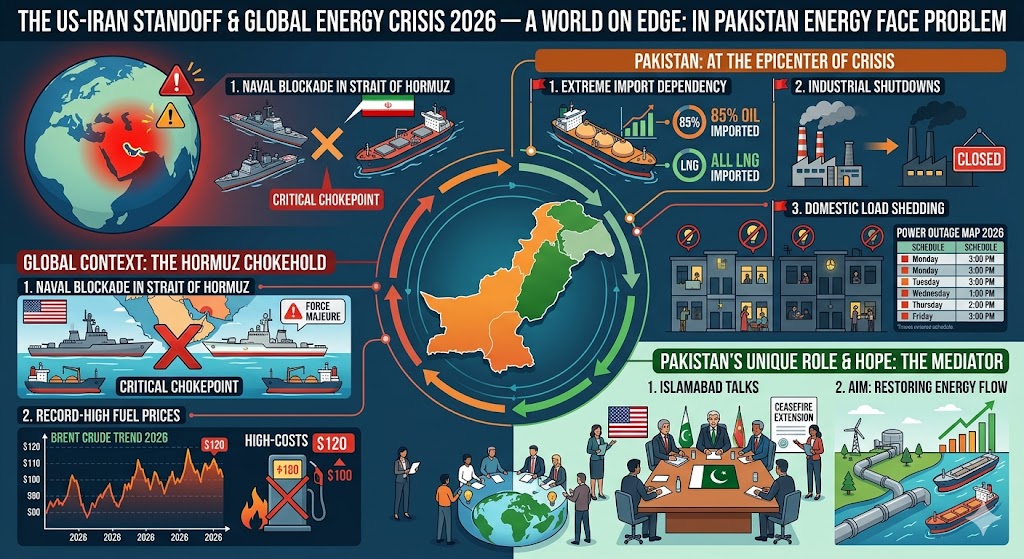

The US-Iran Standoff & Global Energy Crisis 2026 — A World on Edge: In Pakistan Energy …….
The world is holding its breath. A critical two-week ceasefire between the United States and Iran is set to expire today. The tension in the Persian Gulf has not been this high since the height of the Cold War. Oil prices are soaring. Global markets are unstable. And millions of people around the world are feeling the impact on their daily lives.
At the center of this crisis is the Strait of Hormuz — a narrow waterway that handles nearly 20% of the world’s oil supply. The US has imposed a naval blockade. Iran has threatened to close the Strait entirely. And the world is caught in the middle.
In a surprising diplomatic move, President Donald Trump has temporarily extended the ceasefire at Pakistan’s request. But tensions remain dangerously high. Global powers, including China, Russia, and Qatar,r are urging restraint. But will their calls be enough to prevent renewed hostilities?
At the same time, the world is marking Earth Day 2026 under the theme “Our Power, Our Planet.” The irony is striking. Even as leaders gather to discuss renewable energy and climate action, the global energy system remains dangerously dependent on a few chokepoints in the Middle East.
This comprehensive guide explains everything you need to know about the US-Iran standoff, the global energy crisis, and what it means for your wallet and the world.

Part 1: The US-Iran Standoff — How We Got Here
The conflict between the United States and Iran is not new. It spans decades. But the current crisis has its roots in specific events that unfolded over the past few years.
The History of US-Iran Relations
US-Iran relations have been hostile since the 1979 Iranian Revolution and the subsequent hostage crisis. For over 40 years, the two nations have been locked in a cold war of sanctions, proxy conflicts, and diplomatic tensions.
The 2015 Iran nuclear deal (formally known as the Joint Comprehensive Plan of Action or JCPOA) was a brief moment of hope. Iran agreed to limit its nuclear program in exchange for relief from economic sanctions. The deal was supported by the United Nations, the European Union, China, Russia, France, Germany, and the United Kingdom.
But in 2018, President Trump withdrew the United States from the deal. He called it “the worst deal ever negotiated.” His administration reimposed harsh sanctions on Iran. This move infuriated Iran and its allies. It also put the US at odds with European allies who remained committed to the deal.
Since then, tensions have escalated steadily. Iran has increased its nuclear activities. The US has added more sanctions. There have been attacks on oil tankers, drone strikes, and near-misses that brought the two countries to the brink of war.
The Current Crisis: Naval Blockade in the Strait of Hormuz
The immediate trigger for the current standoff was a series of incidents involving commercial shipping in the Persian Gulf. According to US intelligence, Iran-backed forces were accused of harassing and attacking oil tankers transiting the Strait of Hormuz.
In response, the US deployed additional naval assets to the region. The US Fifth Fleet, based in Bahrain, established a de facto blockade. US warships began stopping and inspecting Iranian vessels. Iran responded by deploying its own naval forces and threatening to close the strait entirely.
For two weeks, a fragile ceasefire has held. But that ceasefire expires today. The world is watching to see what happens next.
📌 Why the Strait of Hormuz Matters
- 20% othe f global oil supply passes through this 21-mile-wide strait.
- 25% of liquefied natural gas (LNG) also transits this waterway.
- Over 20 million barrels of oil per day flow through the strait.
- If blocked, oil prices could spike to $200-$300 per barrel.
- The Strait is the only sea route from the Persian Gulf to the open ocean.
Part 2: Pakistan’s Diplomatic Role — A Surprising Mediator
In a surprising development, Pakistan has emerged as a key diplomatic player in the crisis. Prime Minister Shehbaz Sharif held urgent talks with both US and Iranian officials. According to sources close to the negotiations, Pakistan offered to mediate between the two sides.
President Trump agreed to extend the ceasefire temporarily at Pakistan’s request. This is a significant diplomatic victory for Pakistan, which has traditionally maintained close ties with both the US and Iran while also having deep strategic relationships with China and Saudi Arabia.
Pakistan’s role is particularly important because of its geographical position. It shares a long border with Iran. Instability in Iran directly affects Pakistan’s security and economic interests. Moreover, Pakistan relies on energy imports that could be disrupted by a conflict in the Gulf.
However, the extension is only temporary. The underlying issues remain unresolved. Iran wants sanctions relief and recognition of its right to peaceful nuclear technology. The US wants guarantees that Iran will not develop nuclear weapons and will stop supporting militant groups in the region.
Without a comprehensive agreement, the ceasefire could collapse at any moment.
Part 3: Global Powers React — China, Qatar, Russia, and Europe
The US-Iran standoff is not a bilateral issue. It affects the entire world. Global powers have been urging restraint, but their interests are not all aligned.
China’s Position
China is Iran’s largest trading partner. It has invested billions of dollars in Iran’s energy sector as part of its Belt and Road Initiative. China also relies on Gulf oil for its massive economy. A conflict in the Strait of Hormuz would be disastrous for China.
Beijing has called for “maximum restraint” from all parties. Chinese officials have also offered to mediate. However, China is unlikely to pressure Iran too strongly, given their strategic partnership. China also views the US presence in the Gulf with suspicion.
Qatar’s Mediation Efforts
Qatar has positioned itself as a neutral mediator in regional conflicts. It has good relations with both the US (which hosts a major air base in Qatar) and Iran (with whom it shares a massive gas field).
Qatari officials have been shuttling between Tehran and Washington. Their goal is to prevent a military confrontation that would devastate the region. Qatar has also offered to help facilitate diplomatic talks.
Russia’s Strategic Calculus
Russia has deepened its relationship with Iran in recent years. The two countries coordinate closely on military matters, including in Syria. Russia also sees the US-Iran conflict as an opportunity to weaken American influence in the Middle East.
However, Russia does not want a full-scale war. Such a conflict would destabilize the region and could draw in other powers. Moscow has called for diplomacy but has also criticized US “provocations” in the Gulf.
Europe’s Dilemma
European powers — particularly France, Germany, and the United Kingdom — remain committed to the 2015 nuclear deal. They have been trying to salvage the agreement even after the US withdrawal. European officials have urged both sides to de-escalate.
But Europe has limited leverage. It cannot force Iran or the US to change course. And European economies would be severely impacted by a spike in energy prices.

Part 4: Global Energy Crisis — Soaring Prices and Market Instability
The most immediate impact of the US-Iran standoff has been on global energy markets. Oil prices have soared to levels not seen in over a decade. And the worst may be yet to come.
Current Oil Price Situation
As of this writing, Brent crude oil is trading at approximately $135 per barrel. West Texas Intermediate (WTI) is at $128 per barrel. This represents a 40% increase since tensions began escalating in the Gulf.
Analysts warn that prices could go much higher. If the Strait of Hormuz is blockaded or closed, prices could spike to $200-$300 per barrel. Some worst-case scenarios predict $400 per barrel.
For context, oil prices were below $80 per barrel just two years ago. The current prices are already straining household budgets and business operations around the world.
Impact on Pakistan
Pakistan is particularly vulnerable to the energy crisis. The country imports approximately 80% of its oil needs. Petrol and diesel prices have already increased multiple times in recent months.
Current petrol prices in Pakistan are around PKR 320 per liter. If oil prices continue to rise, experts predict petrol could reach PKR 400-450 per liter. This would have a cascading effect on the entire economy.
- Transportation costs would rise, increasing the price of goods.
- Electricity prices would increase, as much of Pakistan’s power is generated from oil and gas.
- Inflation would worsen, hurting households across the country.
- Industrial output could decline, leading to job losses.
- The current account deficit would widen, putting pressure on the rupee.
Global Impact
The energy crisis is global. No country is immune. Here is how different regions are being affected:
| Region | Impact |
|---|---|
| United States | The average gasoline price is now $5.50 per gallon. Inflation at 7.2%. Election-year pressure on President Trump. |
| European Union | Energy costs have tripled since 2024. Germany is considering energy rationing. France is restarting coal plants. |
| China | Economic growth is slowing. Manufacturing PMI at 48.5 (contracting). Beijing is releasing strategic reserves. |
| India | Petrol above ₹120 per liter. Rupee at record low. Government cutting taxes on fuel. |
| Japan & South Korea | Both countries are heavily dependent on Middle East oil. Exploring alternative suppliers. |
| Developing Nations | Severe pressure on currencies and budgets. Risk of social unrest as prices rise. |
Part 5: Earth Day 2026 — “Our Power, Our Planet”
In the midst of this crisis, the world is observing Earth Day 2026 under the theme “Our Power, Our Planet.” The irony is stark. Even as leaders gather to discuss renewable energy and climate action, the global energy system remains dangerously dependent on fossil fuels from a volatile region.
Earth Day 2026 comes at a critical moment. The latest report from the Intergovernmental Panel on Climate Change (IPCC) warns that the world is running out of time to prevent catastrophic climate change. Global temperatures have already risen by 1.3°C above pre-industrial levels. The 1.5°C target is slipping away.
Yet the response from world governments has been inadequate. The US-Iran standoff is a stark reminder that fossil fuel dependence is not just an environmental problem. It is also a security problem and an economic problem.
Key Themes of Earth Day 2026
- Energy Independence: The crisis in the Gulf shows why countries need to diversify their energy sources. Solar, wind, and nuclear power are not subject to geopolitical blackmail.
- Renewable Investment: Global investment in renewable energy needs to triple to meet climate goals. The current crisis could accelerate that shift if governments respond wisely.
- Energy Efficiency: Reducing energy waste is the fastest and cheapest way to reduce fossil fuel demand. Simple measures like better insulation and more efficient appliances make a big difference.
- Just Transition: The shift to clean energy must be fair to workers and communities that depend on fossil fuels. No one should be left behind.
- Youth Leadership: Young people around the world are demanding action on climate change. Their voices are growing louder and more influential.

Part 6: Possible Scenarios — What Happens Next?
As the ceasefire expires, there are several possible paths forward. Each scenario has dramatically different consequences for the world.
Scenario 1: Successful Diplomacy (Best Case)
In this scenario, the temporary ceasefire is extended further. Pakistan, Qatar, or another mediator broker a breakthrough. The US agrees to limited sanctions relief in exchange for Iranian commitments on nuclear activities and regional behavior.
The naval blockade is eased. Oil flows return to normal. Prices gradually decline. Global markets stabilize. The crisis fades from headlines.
Likelihood: Moderate. Both sides have reasons to avoid war. But deep mistrust remains.
Scenario 2: Continued Standoff (Base Case)
In this scenario, the ceasefire expires, but active hostilities do not begin. The blockade continues. Iran does not close theStraitt but threatens to do so. Oil prices remain elevated ($120-150 per barrel).
The global economy slows. Inflation remains high. Central banks continue raising interest rates. Recession risks increase. Diplomatic efforts continue but produce no breakthrough.
Likelihood: High. This is the most probable outcome in the near term.
Scenario 3: Limited Military Confrontation
In this scenario, a skirmish occurs. Perhaps an Iranian fast boat approaches a US warship. Perhaps a drone is shot down. There are casualties on one or both sides.
The US conducts limited strikes on Iranian targets. Iran retaliates against US bases or allies in the region. The strait remains open, but shipping is disrupted.
Oil prices spike to $180-200 per barrel. Global markets panic. A recession becomes likely.
Likelihood: Low to moderate. The risk of miscalculation is real.
Scenario 4: Full-Scale War (Worst Case)
In this catastrophic scenario, Iran closes the Strait of Hormuz. The US responds with military force to reopen it. Full-scale war erupts.
Oil prices exceed $300 per barrel. The global recession is immediate and severe. Millions of barrels of oil are taken off the market. The global economy grinds to a halt.
The war spreads. Hezbollah attacks Israel. Houthi forces attack Saudi Arabia. The entire Middle East is engulfed in conflict.
Likelihood: Low. Neither side wants this outcome. But the risk of escalation cannot be dismissed.
Part 7: What You Can Do — Practical Advice
While geopolitical events may seem beyond individual control, there are practical steps you can take to protect yourself and your family.
1. Reduce Energy Consumption
- Drive less. Combine trips. Use public transportation when possible.
- Improve home insulation. Seal drafts. Use energy-efficient appliances.
- Switch to LED light bulbs. They use 75% less energy.
- Unplug devices when not in use. Phantom power consumption is real.
2. Consider Renewable Energy
- If you own a home, explore solar panels. Prices have dropped dramatically.
- Even small solar systems can reduce your electricity bill.
- Look into government incentives for renewable energy.
3. Manage Your Finances
- Build an emergency fund. Aim for 3-6 months of expenses.
- Reduce debt. High interest rates make debt expensive.
- Diversify your investments. Consider inflation-protected assets.
- Stay informed but avoid panic. Emotional decisions are often wrong.
4. Support Peaceful Solutions
- Stay informed about the issues. Understand both perspectives.
- Support organizations that promote diplomacy and conflict resolution.
- Engage with your elected representatives. Urge them to support peaceful solutions.
📢 Need Content for Your Energy or Finance Blog?
Crazy Vocal writes SEO-optimized articles on geopolitics, energy, economics, and current affairs. Let us help you create content that ranks.
WhatsApp: +92 322 9969786
Email: info@crazyvocal.com
Free consultation — no pressure, just honest advice.
Part 8: The Path Forward — Long-Term Solutions
The current crisis will eventually pass. But unless underlying issues are addressed, similar crises will recur. Long-term solutions require addressing both the geopolitical and energy dimensions.
Geopolitical Solutions
- Revive the nuclear deal: A renewed JCPOA would provide Iran with sanctions relief in exchange for nuclear limits. It would not solve all problems, but it would reduce the risk of war.
- Regional dialogue: Iran and Gulf Arab states need to establish direct communication channels. Confidence-building measures can reduce tensions.
- Economic integration: Trade and investment create interdependence, which reduces the likelihood of conflict.
Energy Solutions
- Accelerate renewable energy: Solar and wind are now cheaper than fossil fuels in many markets. Governments need to remove barriers to deployment.
- Invest in energy storage: Batteries and other storage technologies make renewable energy reliable 24/7.
- Expand nuclear power: Modern nuclear plants are safe and provide carbon-free baseload power.
- Improve energy efficiency: The cheapest energy is the energy you do not use.
📅 Key Dates to Watch
- Today: Ceasefire expires. The world watches for an Iranian or US response.
- Next 48 hours: Critical period for diplomacy. Pakistan and Qatar are expected to continue mediation efforts.
- Next week: UN Security Council emergency session scheduled.
- May 2026: OPEC+ meeting. A potential production increase could ease prices.
- June 2026: US midterm election campaigns intensify. Pressure on President Trump from both sides.
Conclusion: A World at a Crossroads
The US-Iran standoff is more than a bilateral conflict. It is a symptom of a global energy system that is dangerously vulnerable. The Strait of Hormuz is a chokepoint that gives a small number of actors enormous leverage over the entire world economy.
Earth Day 2026 reminds us that we have the power to change this system. Solar, wind, nuclear, and other clean energy sources are not subject to geopolitical blackmail. Every investment in renewable energy is an investment in energy security and peace.
In the short term, we must hope that diplomacy prevails. War benefits no one. The ceasefire extension, even if temporary, is a positive sign. Pakistan’s mediation role is commendable. Global pressure for restraint is essential.
In the long term, we must accelerate the transition away from fossil fuels. The next oil crisis is not a matter of if, but when. The only way to truly end the cycle of energy-driven conflict is to reduce our dependence on oil and gas.
As individuals, we can make choices that matter. Drive less. Use energy more efficiently. Support clean energy policies. Stay informed. And never underestimate the power of ordinary people to push for change.
The world is at a crossroads. The decisions made in the coming days, weeks, and months will shape the future for decades. Let us hope that wisdom, patience, and diplomacy prevail.
📝 Need Expert Content on Geopolitics, Energy, or Economics?
Crazy Vocal provides high-quality, SEO-optimized articles on complex global issues. Whether you need analysis, explainers, or opinion pieces — we deliver.
Internal Links: Blog Posts That Rank | SEO Creative Writing | How to Make Money Online 2026 | Zero to Hero Business Ideas | How to Get Your First Client in 7 Days
📌 Focus Keyword: US-Iran standoff, global energy crisis
📌 Secondary Keywords: Strait of Hormuz blockade, oil prices 2026, Trump Iran policy, Earth Day 2026, Our Power Our Planet, energy security, Iran nuclear deal, global energy crisis explained
© 2026 Crazy Vocal — All rights reserved.